 |
NetSim Source Code Help
|
|
NetSim Source Code Help
|

Go to the source code of this file.
Functions | |
| int | fn_NetSim_CR_CreateServiceFlow (NETSIM_ID nDeviceId, NETSIM_ID nInterfaceId, int nId, NetSim_PACKET *packet, double dTime) |
| int | fn_NetSim_CR_BS_ProcessDSAReq () |
| int | fn_NetSim_CR_CPE_ProcessDSA_RSP () |
| int | fn_NetSim_TerminateServiceFlow (NETSIM_ID nDeviceId, NETSIM_ID nInterfaceId, NetSim_PACKET *pstruPacket) |
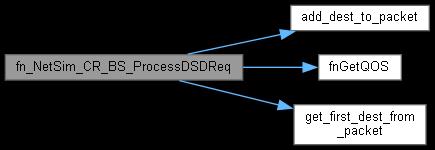
| int | fn_NetSim_CR_BS_ProcessDSDReq () |
| int | fn_NetSim_CR_CPE_ProcessDSD_REP () |
| int fn_NetSim_CR_BS_ProcessDSAReq | ( | ) |
To manage the various traffic flows between CPEs and the BS, the MAC protocol shall have the capability to dynamically manage the addition, deletion, and change of service flows. The format of a Dynamic Service Addition Request (DSA-REQ) message is shown in Table.
This message is sent either by a CPE or BS and is to create a new service flow,and shall not contain parameters for more than one service flow.The FID field carried in the MAC header of the PDU where this message is transmitted shall be the primary management FID of the CPE.
Definition at line 111 of file DSx.c.


| int fn_NetSim_CR_BS_ProcessDSDReq | ( | ) |
| int fn_NetSim_CR_CPE_ProcessDSA_RSP | ( | ) |
A DSA-RSP message shall be generated in response to a received DSA-REQ message. If the transaction is successful, the DSA-RSP message may contain the following:
Service Flow parameters (the completespecification of the service flow shall be included in the DSA-RSP if it includes a newly assigned FID or an expanded service class name) and CS parameter encodings (specification of the service flow’s CS-specific parameters).
Definition at line 173 of file DSx.c.

| int fn_NetSim_CR_CPE_ProcessDSD_REP | ( | ) |
| int fn_NetSim_CR_CreateServiceFlow | ( | NETSIM_ID | nDeviceId, |
| NETSIM_ID | nInterfaceId, | ||
| int | nId, | ||
| NetSim_PACKET * | packet, | ||
| double | dTime | ||
| ) |
A service flow is a MAC transport service that provides unidirectional transport of packets either to upstream packets transmitted by the CPE or to downstream packets transmitted by the BS. A service flow is characterized by a set of QoS parameters such as latency, jitter, and throughput assurances. In order to standardize operation between the CPE and BS, these attributes include details of how the CPE requests upstream bandwidth allocations and the expected behavior of the BS upstream scheduler.
Definition at line 12 of file DSx.c.

| int fn_NetSim_TerminateServiceFlow | ( | NETSIM_ID | nDeviceId, |
| NETSIM_ID | nInterfaceId, | ||
| NetSim_PACKET * | pstruPacket | ||
| ) |
Any service flow can be deleted with the DSD messages. When a service flow is deleted, all resources associated with it are released. If a service flow for a provisioned service is deleted, the ability to reestablish the service flow for that service is network management dependent. However, the deletion of a provisioned service flow shall not cause a CPE to reinitialize.
Definition at line 213 of file DSx.c.


 1.9.5
1.9.5