Vehicular Ad Hoc Networks
V2V · V2I · DSRC / WAVE · SUMO-coupled
NetSim models the information flow in connected-vehicle networks. The architecture combines the IEEE 1609 (WAVE) upper layers with the IEEE 802.11p and 802.11bd PHY and MAC in the 5.9 GHz band. Couple it with SUMO for realistic road traffic, and modify the stack in the protocol source code in C.
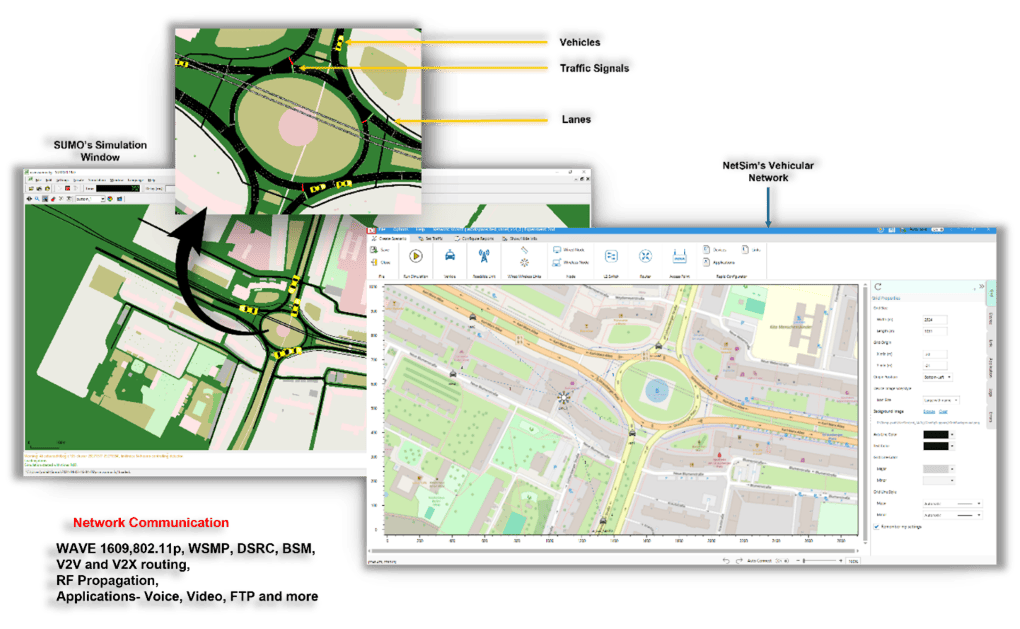
What NetSim models
NetSim simulates the wireless communication between vehicles and infrastructure, including RF propagation. SUMO supplies the road traffic.
WAVE architecture
IEEE 1609 (WAVE) upper layers run over the IEEE 802.11p and 802.11bd PHY and MAC, the standards for vehicular communication.
SUMO coupling
Road traffic runs in SUMO, the open-source urban mobility simulator. NetSim reads vehicle coordinates at runtime through shared-memory pipes and drives mobility from them.
V2V and V2I
Vehicles (on-board units) and roadside units exchange safety and non-safety traffic, and form spontaneous ad hoc networks.
Protocol source in C
The protocol stack ships as C source. Modify it in Visual Studio to implement and test your own algorithms.
The WAVE protocol stack
Each vehicle and roadside unit runs a full stack, from application traffic down to the 5.9 GHz radio.
Vehicular and standard traffic
File transfer, Video, Voice, Email, HTTP and Gaming, together with the BSM safety application.
TCP and UDP
Standard transport protocols carry non-safety application flows across the network.
Ad hoc routing
Spontaneous ad hoc network formation with AODV, DSR, OLSRv1 (RFC 3626), OLSRv2 (RFC 7181) and ZRP.
IEEE 802.11p (OCB)
Stations communicate outside the context of a BSS, with no association or authentication, so links form instantly. Access uses CSMA/CA over separate control and service channels.
802.11p and 802.11bd
OFDM PHY in the 5.9 GHz band with 5, 10 and 20 MHz channels, up to 54 Mbps. 802.11bd adds the newer 10 and 20 MHz modes.
WSMP over IEEE 1609
The WAVE Short Message Protocol carries Basic Safety Messages over IEEE 1609 (1609.1 to 1609.4) outside the IP stack, with no routing.
802.11p and DSRC at a glance
NetSim implements the PHY rates, channel plan and safety messaging of the DSRC/WAVE standards, with configurable parameters.
PHY rates
OFDM rates from 1.5 to 54 Mbps in 5, 10 and 20 MHz channels. NetSim selects the MCS, from BPSK to 64-QAM, from the received power and the receiver sensitivity.
CSMA/CA, no BSS
Outside the context of a BSS, stations skip announcement, scanning and association. A SIFS idle check and a random back-off window manage contention.
DSRC channels
One control channel (CCH 178, 5.890 GHz) for safety and management, plus service channels for non-safety traffic. Devices alternate CCH and SCH within a configurable synchronisation interval, 100 ms by default.
BSM safety messages
A 20-byte Basic Safety Message, broadcast at a nominal 10 Hz over WSMP and IEEE 1609. You can configure it as broadcast (single hop) or unicast.
Realistic road traffic with SUMO
NetSim interfaces with SUMO, the open-source road-traffic simulator. SUMO computes the vehicle positions over time from the road conditions. NetSim simulates the wireless communication and the RF propagation in the physical layer.
Pipes, a section of shared memory, connect the two simulators. Import a SUMO road network and its vehicle flows straight into the NetSim GUI, then add roadside units where you need them. Mobility can also come from file-based traces or the inbuilt random models.

What you can study
Worked examples from the VANET manual, ready to load, run, and extend.
Import a SUMO scenario
Load a road network and its vehicle flows from SUMO, then run wireless communication over the imported topology.
V2V and V2I with RSUs
Set up vehicle-to-vehicle and vehicle-to-infrastructure communication between vehicles and roadside units.
SCH and CCH time division
Measure throughput, delay and collisions as you change the control and service channel intervals, and as the node count and generation rate increase.
Manhattan mobility, multi-hop
Single-hop and multi-hop communication over a SUMO Manhattan-grid mobility model, including vehicles moving in a closed loop.
Performance metrics and log files
Time-series plots and a result dashboard appear when a run completes. The trace and radio-measurement logs give more detail.
Time-series plots
Application throughput and latency, link throughput and other metrics, plotted over the course of the simulation.
Network metrics
Packets transmitted and received, errors, collisions and retransmissions, for each device or each application flow.
Packet trace
A per-packet log of arrival, queuing and departure times, payload, overhead, errors and collisions, through each device on the path.
Radio measurements log
Per-packet path loss, shadowing, fading, transmit and receive power, SNR, SINR, interference, spatial streams, BER and MCS index.
Featured projects and research
These NetSim projects, with documentation and code, extend the VANET library into active research areas.
Road safety
UAV-to-vehicle communication for accident alert and rerouting: monitor traffic and warn vehicles when an accident occurs.
View project →Traffic optimisation
Dynamic traffic light control: vehicles and roadside units cooperate to adjust signals based on traffic conditions and ease congestion.
View project (PDF) →AI/ML for VANETs
An ML-based classifier for Sybil node detection, plus offline and online machine-learning interfacing with NetSim.
View project (PDF) →Clustering with RSUs
RSU-based dynamic clustering in vehicular networks, with roadside units as cluster heads and MATLAB interfacing.
View project (PDF) →Publications that used NetSim
These peer-reviewed VANET and vehicular-network papers used NetSim to build and validate their models.
Watch it in action
Webinars on NetSim-SUMO co-simulation and vehicular network research.
 ▶
▶
NetSim-SUMO Co-Simulation for VANETs (Part 1 of 2)
 ▶
▶
NetSim-SUMO Co-Simulation for VANETs (Part 2 of 2)